ishan.asati.

Vol. 012026 · India

Vol. 01Issue 2026India

I build
to understand.

Notes from a student who learns by making things: a skin-image classifier, a study coach that argues back, a quieter place to focus, and a few circuits on the bench.

Portrait of Ishan Asati
Ishan AsatiIndia / 2026

Words and work by Ishan Asati

Six chapters, one working record

Scroll

A note before the work

There is a kind of learning that only happens when something has to run.

Most of what I know arrived through projects that were slightly beyond me at the start. A model that had to classify images. A study plan that had to survive a real week. A timer that had to be quiet enough to use. The making came first; the understanding followed.

I am a student in India, working across artificial intelligence, software and the physical edge of computing. I do not have a single stack, and I have stopped treating that as a flaw. The through-line is a preference for understanding the whole system — and for making ideas into something that runs.

“Build, observe, revise. Then say plainly what is real and what is still a sketch.”

Chapter one

Curiosity, kept
in the open.

I am less interested in collecting disciplines than in following a question until it becomes a thing that works.

I move between machine learning, software engineering and embedded systems because the questions do.

A vision model raises questions about data and trust. A study tool raises questions about memory and attention. A circuit raises questions about timing, voltage and the gap between a diagram and a wire.

The interests rarely stay in one place. That is how I like it. The point was never to look like someone who has arrived. It was to keep the questions close enough to work on.

Chapter two

Three things,
built to find out.

Each began with a question that a plan alone could not answer.

Research study · 2026

A score is not a system.

A computer-vision study in skin-image classification — built to understand the gap between a model that scores well and a system that deserves trust.

DermoAI classifies skin images into twelve categories. It uses a ConvNeXt-Base backbone, a classification head adapted to the problem, and test-time augmentation at inference. It placed first in the DAV ML Khanna machine learning competition.

None of that makes it a medical device. The project is a research study, evaluated within itself: 82.79% reported accuracy and 87.30% cancer-class sensitivity. The distance between those numbers and a system that deserves trust is the actual subject of the work.

Output classes
12
DAV ML Khanna competition
1st
Read the DermoAI studyRepository
Fig. 01 — Classification studyConvNeXt-Base / TTA
82.79%Reported accuracy
87.30%Cancer-class sensitivity
12Output classes
Research prototype — not clinically validatedI. Asati
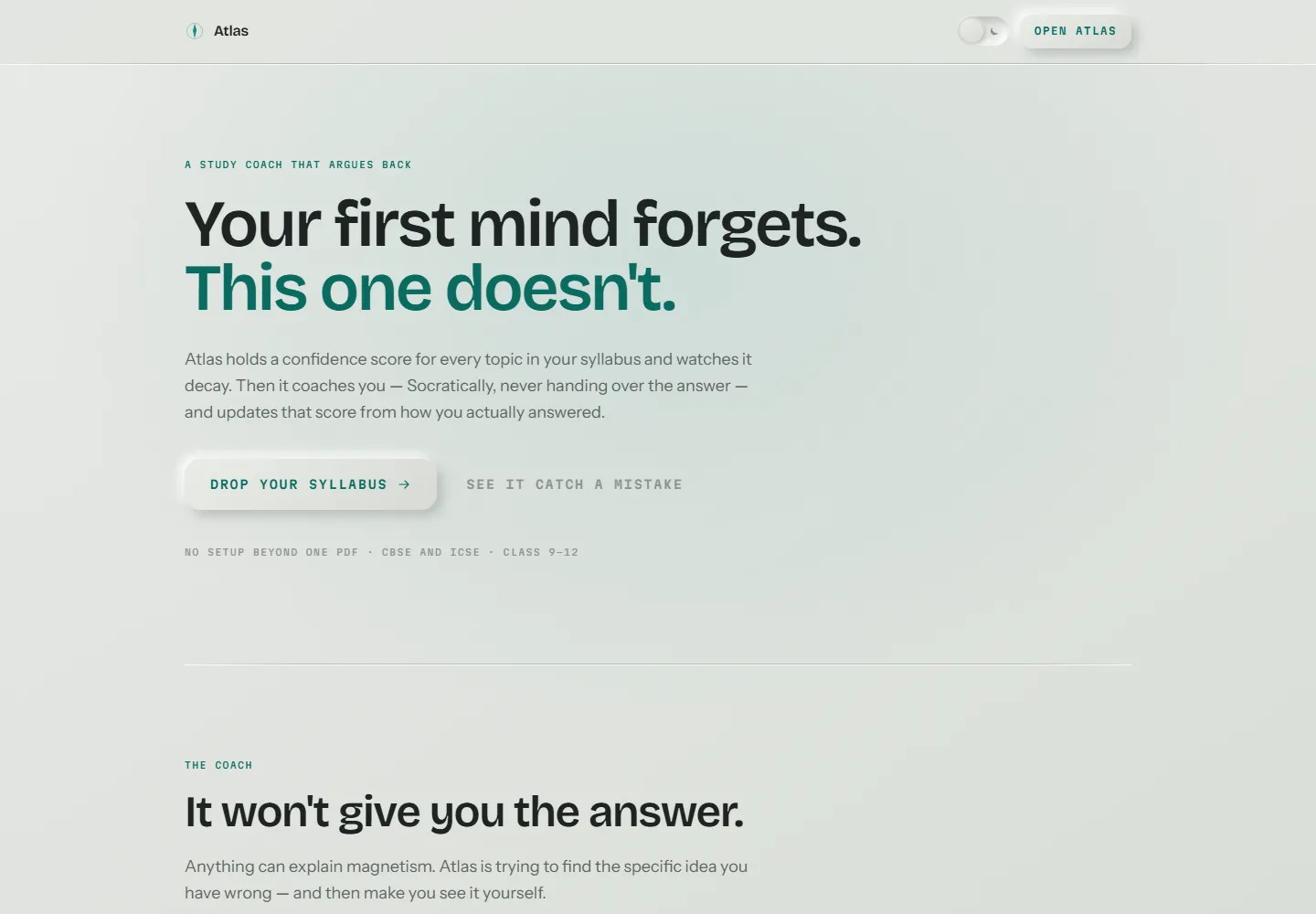
Fig. 01 — DermoAIResearch study

Study operating system · In development

The plan that argues back.

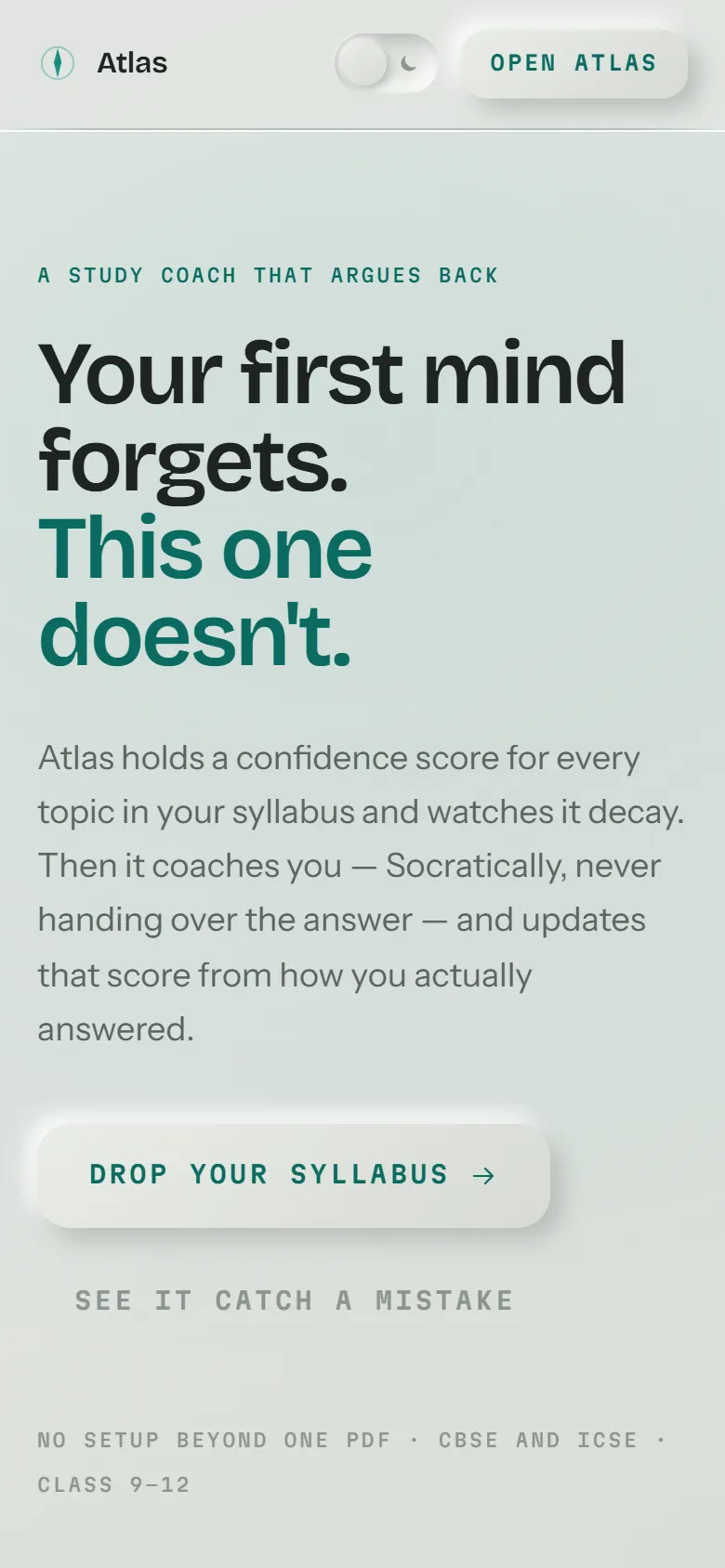
A study coach that argues back. Atlas watches what you actually know, lets the number decay, and asks the next question instead of handing over the answer.

Atlas keeps a confidence score for every syllabus topic, lets that score decay, and asks the next question instead of handing over the answer. A syllabus PDF is extracted into subjects and topics; a streaming coach handles the conversation.

The screens for the full loop exist. The mission-planning pipeline is still mocked, and this entry says so. A demo that hid that difference would be a different, less useful product.

Screens built
6
Streaming coach
Live
Read the Atlas case studyLive demo
Fig. 03 — Study operating systemLanding / welcome
Atlas landing page: a study coach that argues back, with a Socratic coaching exchange.
PDF extractionStreaming coachConfidence model
Next.js · DeepSeek · AppwriteSix screens built
Fig. 03 — AtlasIn development

Focus workspace · Complete build

Make room for one thing.

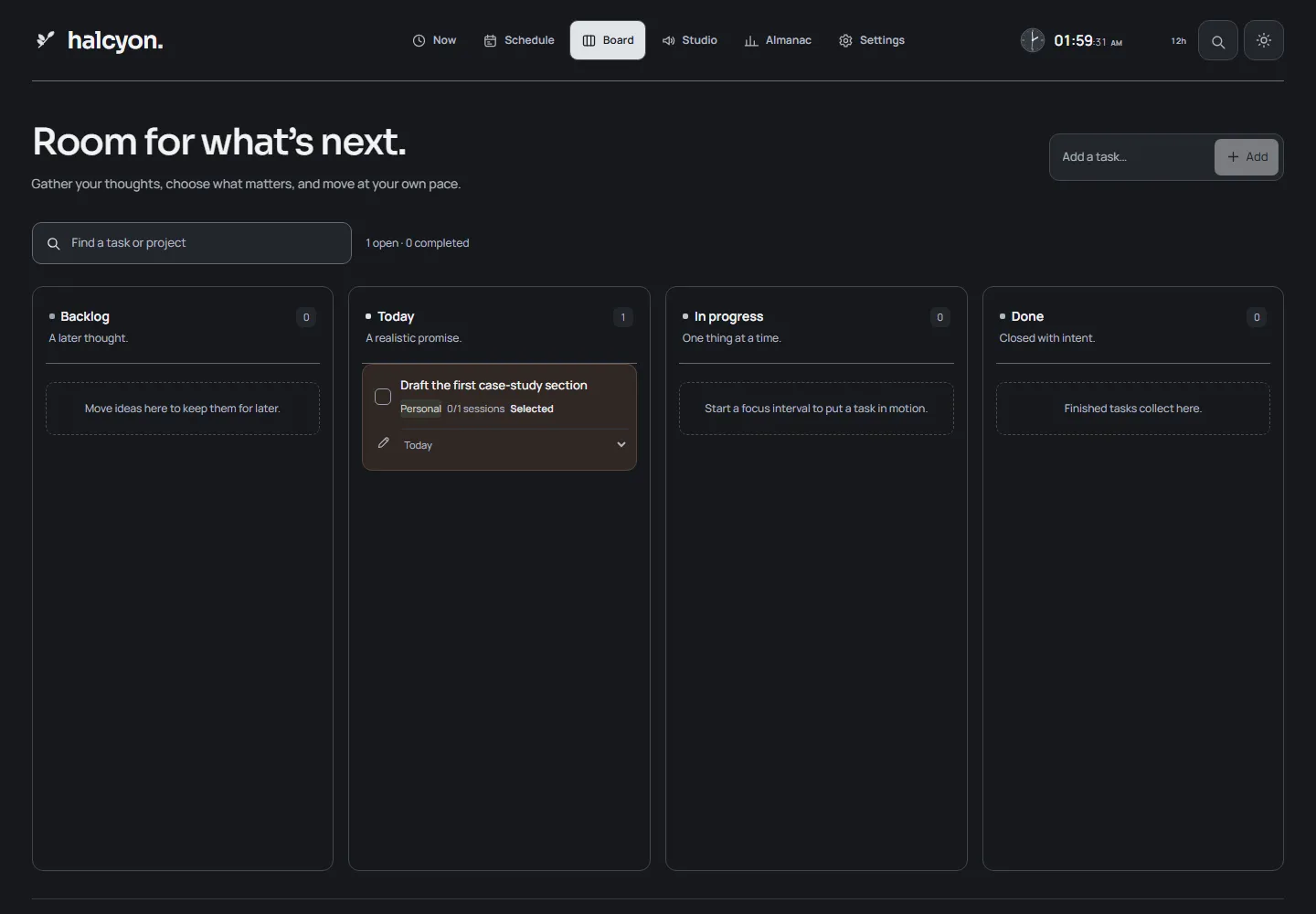
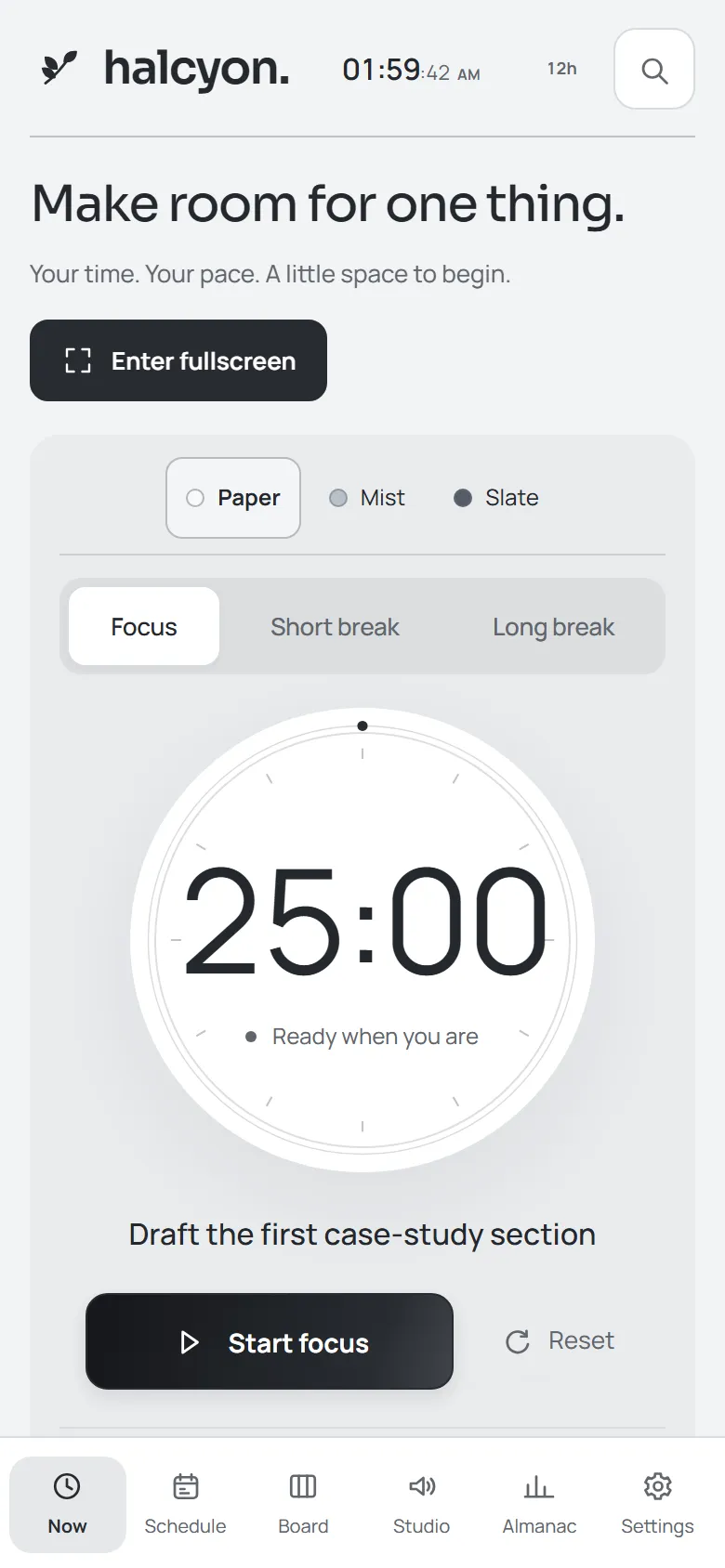
A quiet workspace for attention: one timer with room to breathe, a plan you can argue with, a place for stray thoughts, and a small studio for the silence between.

Halcyon is a local-first focus workspace: a timer with room to breathe, a dated schedule you can argue with, a place for stray thoughts, a four-voice sequencer and a weekly almanac.

It has six destinations and no account. Everything lives in the browser. The completeness is the point — a quiet tool that asks for nothing beyond the next session.

Destinations
6
Sound studio
4 × 16
Read the Halcyon case study
Fig. 05 — Focus ritualBoard / dark theme
Halcyon board view with backlog, today, in progress and done columns.
Local-firstFocus timerAmbient studio
Next.js · TypeScript · IndexedDBAccount-free
Fig. 05 — HalcyonComplete build

Chapter three

Build. Observe.
Revise.

A portfolio is more useful when it says where each thing actually stands.

The ledger below is the whole index, not a highlight reel.

Two entries are complete builds. Two are in development. One is a research study. One collects prototypes and concepts. One is deliberately empty. The status column is the most honest sentence on this page.

Seven entriesEvery status stated as it isOpen the index

Chapter four

A syllabus
I set myself.

In use means it appears in something I have built.Exploring means I am still learning my way around it.

  1. Artificial intelligence

    Machine learning, computer vision, neural architectures and local models.

    In use
  2. Software engineering

    Application architecture, TypeScript, React and the craft of shipping.

    In use
  3. Hardware & robotics

    ESP32, sensors, displays and small systems that meet the physical world.

    Exploring
  4. Systems & open source

    Linux, tooling and how software actually meets the machine.

    Exploring
  5. Creative programming

    Python, Pygame and interactive experiments made for curiosity.

    Exploring

Chapter five

The margin.

Notes, when there is something worth standing behind.

The shelf is empty on purpose.

Writing takes longer than building. I would rather publish nothing than publish something manufactured to fill a page. The first entries will appear when they are actually written, edited and worth your time.

Visit the notes index

Planned, not published

03
  1. 01

    What I am learning about machine learning

    Evaluation, failure modes and the distance between a score and a system.

  2. 02

    Building local-first software

    Notes from Atlas Fit on state, storage and owning your own data.

  3. 03

    Electronics, from the bench

    Sensors, timing, wiring mistakes and the things that only appear in hardware.

Epilogue

A question,
a correction, or a
half-formed idea?

Email is a real inbox, read by a real person. It is the best place to start a conversation about a project, a shared interest or something this site got wrong.

hello@smartfools.inThe contact page